Titanium earns its price tag, though. TIMET lists Ti-6Al-4V at 4.43 g/cm³, roughly 56% of steel's density, with service recommended from -210°C to 400°C and solid resistance to seawater attack at normal ocean temperatures — properties that explain why aerospace, defense, and medical engineers keep specifying it.
Investment casting offers a way to get complex titanium geometry near net shape, cutting the machining burden significantly. But titanium reacts with oxygen, nitrogen, and standard mold materials, so the process demands tighter controls than casting steel or aluminum. This article covers how the process works, where it delivers value, what it costs, and how to vet a supplier before committing to production.
Key Takeaways
- Part geometry, volume, material grade, and tolerance requirements determine whether titanium investment casting fits your project
- Vacuum or inert-atmosphere melting, compatible shell materials, and rigorous inspection separate reliable castings from scrap
- Total cost includes tooling, machining, testing, freight, duties, and inventory — not just the casting quote
- A sourcing partner can coordinate technical specs, supplier communication, and delivery logistics on your behalf
Titanium Investment Casting Explained
What Is Investment Casting?
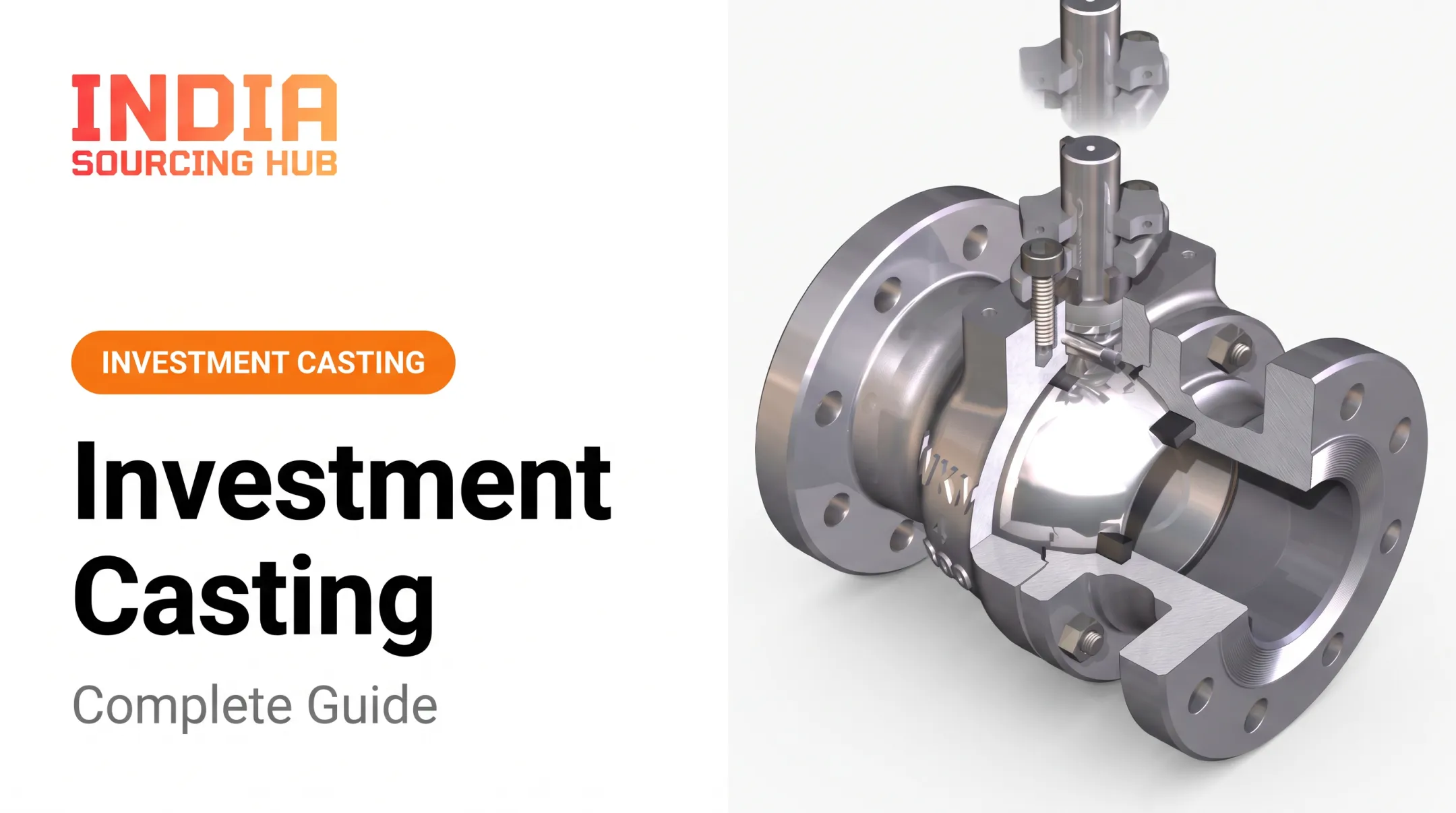
Investment casting, also called lost-wax casting, starts with a disposable wax or polymer pattern. That pattern gets coated repeatedly in ceramic slurry and stucco until it forms a hard shell. The wax melts out, molten metal fills the cavity, and the shell gets broken away to reveal a near-net-shape part.
The Investment Casting Institute describes this general sequence for metals across the board. Titanium follows the same basic path, with several critical exceptions.
Why Titanium Casting Differs
Molten titanium reacts with oxygen, nitrogen, and many conventional mold materials. That reaction can produce a hardened, brittle surface layer called alpha case, along with porosity or inclusions if the melt environment isn't controlled.
This means titanium foundries need:
- Vacuum or inert-gas melting equipment
- Shell materials selected specifically to limit chemical reaction
- Tight control over pour temperature and hold time
Selecting a Titanium Grade
Common casting grades include commercially pure titanium (C-2, C-3) for corrosion resistance when strength demands are moderate, and Ti-6Al-4V (C-5) for structural parts that need a higher strength-to-weight ratio.
Three separate specifications apply depending on end use:
- ASTM B367: general industrial castings
- ASTM F1108: surgical implant castings (mandatory vacuum casting and hot isostatic pressing, or HIP)
- AMS4985: aerospace investment castings with HIP
Verify the correct specification and current revision against your customer's requirements. Don't assume one covers the others.
Is Casting Right for This Part?
Ask these questions before committing to tooling:
- Does the geometry include internal features, thin walls, or complex contours that would be costly to machine from billet?
- Is annual volume high enough to justify tooling investment?
- Can the specified tolerances be met with casting plus limited machining?
- Does the application require documented NDT, chemical analysis, or material certification?
How the Titanium Investment Casting Process Works
Pattern and Tooling Development
The supplier converts your drawing or 3D model into wax tooling. Draft angles, wall thickness, radii, and anticipated shrinkage all get reviewed before tooling is cut. This is where design-for-manufacturing conversations happen, and skipping them tends to cause problems downstream.
Shell Building and Preparation
Wax patterns get dipped in ceramic slurry and coated with stucco repeatedly, building a shell layer by layer. For titanium, shell chemistry matters more than for most metals. A 2015 industry study found that yttria facecoats produced less alpha case than zirconia when casting Ti-6Al-4V. The same study still recommended lower pour temperatures and rapid cooling regardless of shell material.
After the shell cures, the wax is removed (dewaxing), and the shell is fired, preheated, and dried under controlled conditions before pouring.
Melting and Pouring
Titanium requires specialized melting equipment — cold-hearth, vacuum arc, or induction-skull systems operating under high vacuum or inert gas. ASTM B367 lists several approved reactive-metal melt routes, including consumable-electrode and plasma-arc processes. The right method depends on the alloy and the foundry's equipment.
Gravity, centrifugal force, or pressure-assisted filling help molten titanium reach thin or intricate sections before it solidifies.
Finishing and Inspection
A casting isn't a finished part. Expect gate removal, grinding, heat treatment, and often HIP before the part meets spec.
Post-casting steps typically include:
- Shell removal and cutoff
- Surface grinding and cleanup
- Heat treatment and/or hot isostatic pressing
- Dimensional inspection and radiography
- Chemical analysis and material certification
Watch for alpha case. NIST research on a Ti-6Al-4V investment-cast step wedge measured oxygen enrichment at the zirconia shell interface reaching 6-10 wt% in that specific test. Thickness still varies by shell material, cooling rate, and section size, so measure it rather than assume it.

Benefits, Applications, and Manufacturing Limitations
What Casting Does Well
Investment casting is strongest when you need outcomes machining alone struggles to deliver:
- Consolidates multiple components into a single piece
- Reproduces complex internal geometry without extensive machining
- Stays repeatable once tooling and process are approved
For titanium, that usually means less billet waste and fewer secondary joining operations.
Where Titanium Castings Show Up
- Aerospace and power generation — airfoils and structural components for jet engines and gas turbines
- Defense programs — parts requiring extra inspection, HIP, and certification, as Signicast describes in its aerospace and defense casting work
- Medical implants — ASTM F1108 specifically governs vacuum-cast Ti-6Al-4V surgical implants
- Pumps and valves — housings and bodies where corrosion resistance and weight savings matter
Limitations to Plan For
Titanium's reactivity creates real constraints:
- Shell and crucible compatibility must be verified, not assumed
- Alpha case may require removal via machining, blasting, or chemical milling
- Porosity, cold shuts, or incomplete filling can trigger rejection or repair
- Cast/HIP Ti-6Al-4V can show lower ductility and fatigue than forged, annealed material; added heat treatment improved results in that study
Comparing Your Process Options
| Process | Best for | Tooling cost | Typical volume |
|---|---|---|---|
| Investment casting | Complex geometry, moderate-to-high volume | Moderate-high | Medium to high |
| Forging | Maximum fatigue/structural performance | High | High |
| Billet machining | Low volume, no tooling budget | Low | Low |
| Additive manufacturing | Prototypes, highly complex low-volume parts | Low | Low |
| Titanium MIM | Small parts, often under 20g, very high volume | High | Very high |
If your part demands maximum structural performance under cyclic loading, forging may outperform casting. If you need a handful of units with no budget for tooling, machining or additive manufacturing might make more sense.

Cost, Alternatives, and Supplier Selection
What Drives the Price
Titanium casting costs stack up across several line items:
- Alloy cost and melt losses (titanium scrap doesn't recycle as easily as steel)
- Tooling and pattern development
- Ceramic shell materials and specialized melting time
- Heat treatment, HIP, and machining
- Inspection, testing, and certification paperwork
- Freight, duties, and inventory carrying costs
When Unit Costs Make Sense
Upfront tooling and process qualification are a real investment. Unit economics improve once a part enters repeatable production: tooling amortizes, and process variation drops as the foundry learns that geometry. Get a quotation for your geometry and volume instead of relying on industry averages. Costs vary widely by part complexity and grade.
Process and Sourcing Alternatives
When investment casting isn't the right fit, buyers usually compare:
- CNC machining from billet for lower volumes or simpler shapes
- Powder or additive methods for complex internal features
- Alternate alloys when titanium's strength-to-weight ratio isn't required
- Sourcing regions outside China, including India, to manage tariff exposure and supply risk Section 301 tariffs on specified Chinese steel and aluminum products rose to 25% effective September 27, 2024. That notice does not set a blanket titanium-casting rate; classification depends on the product's HTS code. Many buyers still use it as a prompt to compare alternative sourcing countries during cost planning.
Supplier Qualification Checklist
Before releasing production, ask any supplier:
- Which titanium grades and specifications do you routinely cast?
- What melting and atmosphere controls are in place?
- How do you manage shell and crucible reactions?
- What inspection, NDT, and traceability documents do you provide?
- Which finishing and machining steps happen in-house versus subcontracted? Review first-article samples, dimensional reports, and material certificates before committing to a production run — not after.
Sourcing Titanium Castings for U.S. Manufacturing
Finding a titanium casting supplier overseas means navigating specifications, quality expectations, and logistics in a market you may not visit in person. That's where a sourcing partner earns its keep.
India Sourcing Hub has connected North American manufacturers with Indian metal-product suppliers since 1995. Its Indian factory network has been built to meet the company's quality requirements since 2013.
The company isn't a direct titanium casting manufacturer. It's a sourcing and supply-chain partner that helps identify suitable Indian suppliers and manages the relationship from there.
For buyers evaluating titanium castings, that support typically includes:
- On-site inspection by India-based engineers before shipment on every production run
- Warehousing in Chicago, Toronto, and Rajkot to help smaller and recurring orders work around minimum order quantities
- An alternative to China sourcing that can avoid applicable China-related tariffs on covered parts
- North American personnel managing import logistics and communication during your business day

RFQ Checklist
When requesting a quote for a titanium casting project, have this ready:
| Item | Detail needed |
|---|---|
| Drawing/3D model | Current revision, with GD&T |
| Alloy grade | Ti-6Al-4V, CP titanium, or other |
| Volume | Annual quantity and batch size |
| Tolerances | Target dimensions and critical features |
| Finish | Surface finish and machining scope |
| Certifications | Specification and documentation requirements |
| Delivery | Location and target launch date |
If you're sourcing titanium castings and weighing options against current China pricing, share your drawings, quantities, and delivery timeline with India Sourcing Hub for a sourcing assessment.
Frequently Asked Questions
What is investment casting good for?
Investment casting suits complex, detailed, near-net-shape metal parts that would otherwise require extensive machining. For titanium specifically, it reduces billet waste and can consolidate multiple components into one piece.
Is investment casting expensive?
Upfront tooling and process qualification carry real cost, but unit pricing typically improves with repeatable production volume. Total cost depends on alloy grade, part complexity, volume, and required testing. Get a quote for your specific part.
What are the disadvantages of titanium investment casting?
Titanium's reactivity demands specialized atmosphere control, compatible shell materials, and careful melt management to avoid alpha case or contamination. Expect tooling investment, inspection requirements, and some post-casting machining regardless of supplier.
What is the difference between titanium investment casting and forging?
Casting handles complex geometry and internal features that forging can't easily replicate, while forging generally delivers better fatigue and structural performance for highly loaded parts. The right choice depends on your specific load case, geometry, and production volume.
How do you prevent alpha case in titanium castings?
Prevention depends on compatible shell facecoat materials, controlled melt atmosphere, limited pour temperature and hold time, and validated post-casting inspection or surface removal. No single step eliminates the risk. It requires process control across the whole casting cycle.
How do you choose a titanium investment casting supplier?
Look for verified titanium casting experience, documented atmosphere and shell controls, inspection and traceability capability, and willingness to provide first-article samples before production release. Clear technical communication and realistic lead times matter just as much as price.