Common pain points show up fast. Teams wrestle with excessive post-machining, uncertain quality from overseas suppliers, steep tooling quotes, and lead times that blow past the program schedule. Add the perennial question—investment casting, sand casting, die casting, or straight CNC machining—and sourcing decisions stall.
This guide covers the aluminum investment casting process step by step, its benefits and real limitations, what drives cost, where it fits against competing methods, and how to vet a supplier before you commit to tooling.
Key Takeaways
- Aluminum investment casting (lost-wax) forms parts in a disposable ceramic shell built on a wax or printed pattern.
- Choose it for complex geometries, thin walls, and integrated features when less machining offsets higher tooling cost.
- Pick the process by volume, size, tolerance, alloy, and timeline—not unit price alone.
- Judge total landed cost: tooling, casting, machining, inspection, freight, and inventory together.
What Is Aluminum Investment Casting?
Aluminum investment casting, also known as lost-wax casting, starts with a sacrificial pattern made from wax, resin, or a 3D-printed material. That pattern gets dipped repeatedly in ceramic slurry and stucco to build a shell.
The pattern is then removed, leaving a cavity filled with molten aluminum that solidifies into the final part. "Investment" and "lost-wax" describe the same process: one name refers to the pattern being "invested" in ceramic, the other to the wax being lost during dewaxing.
How It Differs From Die Casting and Sand Casting
The mold type is the core distinction:
- Investment casting uses a disposable ceramic shell built around a disposable pattern, ideal for intricate, near-net-shape geometry.
- Sand casting forms a disposable sand mold around a pattern, typically favoring larger parts or lower quantities.
- Die casting injects molten aluminum into a reusable steel die, which only pays off at higher production volumes.
The Investment Casting Institute's process overview notes that pattern tooling can be reused for recurring runs, while each ceramic shell is single-use. That is why investment casting handles complex detail that sand and die casting struggle to reproduce economically.
The Aluminum Investment Casting Process
Pattern Creation and Assembly
Pattern-making takes two paths. Recurring production typically uses reusable injection tooling to produce wax patterns quickly and consistently. Prototypes and low-volume runs often use 3D-printed or otherwise directly produced patterns, skipping tooling altogether.
Individual patterns attach to a central sprue, forming a tree. Gates and runners are engineered into this assembly to guide molten aluminum into each cavity and support consistent fill.
Building the Ceramic Shell
The pattern tree is dipped in ceramic slurry, coated with stucco (a sand-like refractory), and dried. This cycle repeats multiple times to build shell thickness. Each layer matters:
- Too thin, and the shell can crack or fail during pouring
- Too thick, and dewaxing or shell removal becomes harder
- Drying time between coats affects shell strength and surface quality
Dewaxing, Pouring, and Solidification
Once the shell cures, the wax is removed through steam autoclave or flash-fire methods, leaving a hollow ceramic mold. The shell is then preheated before molten aluminum is poured in.
Specific temperatures vary by alloy and foundry process control. One published 2022 study on A319 alloy used metal heated to 730°C (1,346°F) with shells preheated to 800°C (1,472°F) for 15 minutes. Treat that as a data point, not a universal benchmark across every aluminum grade.
Always confirm exact process parameters with your foundry rather than assuming they carry over from one alloy to another.

Knockout and Finishing
After cooling, the ceramic shell is broken off (knockout), and individual castings are cut from the tree. Remaining steps typically include:
- Gate removal and grinding to clean up attachment points
- Heat treatment to achieve the required mechanical properties
- Blasting or finishing for surface consistency
- Inspection against the part drawing
- CNC machining of critical features that need tighter tolerances than as-cast surfaces allow
Which dimensions stay as-cast versus which get machined depends entirely on the part drawing and the foundry's demonstrated capability. Features like bolt-hole patterns, sealing faces, or bearing bores usually require machining, while non-critical exterior surfaces often don't.
Benefits, Materials, and Design Considerations
Why Aluminum Works for This Process
Aluminum brings a useful mix of properties to investment-cast parts: low density, favorable strength-to-weight ratios, natural corrosion resistance from its oxide layer, and solid thermal and electrical conductivity. That combination makes it a frequent choice for weight-sensitive industrial components: pump housings, valve bodies, and enclosures among them.
Design Benefits Worth Knowing
Investment casting opens design options that are harder or more expensive with other methods:
- Complex contours and undercuts in a single casting
- Thin wall sections without excessive scrap
- Internal passages using cores, avoiding secondary machining
- Part consolidation with fewer welds, fasteners, and assembly steps
Documented examples back this up. One aluminum LP-gas engine valve body incorporated features that eliminated machining steps entirely. A separate aluminum electronics housing used a near-net, one-piece design that cut both machining and assembly time, according to a 2012 Foundry Management & Technology report.
Fewer secondary operations mean fewer places for cost and lead time to creep in.
Choosing an Aluminum Alloy
Alloy selection should match your strength, corrosion, thermal, and heat-treatment requirements, not just availability. Commonly investment-cast aluminum alloys include 319, 355, C355, 356, A356, and A357, though applicable specifications differ by grade.
ASTM B618/B618M-25 covers general-purpose aluminum-alloy investment castings, but its scope specifically flags that highly loaded or safety-critical parts may need additional verification beyond the base spec.
Design-for-Casting Checklist
Before committing to tooling, review these with your foundry:
- Wall uniformity and transition radii (sharp changes invite shrinkage defects)
- Core requirements for internal passages
- Machining allowances on critical surfaces
- Dimensional tolerances and inspection datums
- Surface-finish expectations tied to the part's function
Achievable tolerances and finishes vary by geometry, size, alloy, and foundry process control. One supplier publishes a +/-0.005 inch per inch of length guideline for A356 castings. Treat figures like this as a single data point, not an industry-wide guarantee, and confirm specifics with your own bidders.
Cost, Comparisons, and Production Fit
What's in an Aluminum Investment Casting Quote
A complete quote breaks down into several cost buckets:
- Pattern or tooling
- Engineering and setup
- Alloy and melt charges
- Shell production
- Casting yield (how much metal becomes finished part versus scrap)
- Finishing, heat treatment, and machining
- Inspection, packaging, freight, duties, and inventory carrying costs
No reliable per-part price exists without these inputs:
- Drawing or CAD model
- Alloy specification and dimensions
- Annual quantity and tolerance requirements
- Delivery destination
Anyone quoting a number before seeing those details is guessing.
Investment Casting vs. Sand Casting vs. Die Casting
| Factor | Investment Casting | Sand Casting | Die Casting |
|---|---|---|---|
| Tooling cost | Moderate-higher | Lower | Highest |
| Geometry complexity | High | Moderate | Moderate-high |
| Surface finish | Finer as-cast | Rougher | Smooth |
| Best production fit | Prototypes through mid-volume | Low volume, larger parts | High volume |
| Typical lead time | Weeks | Days to 1-2 weeks | Longer tooling buildout |
According to Dynacast's comparison of die casting and investment casting, investment tooling may cost less upfront than die tooling. Die casting can still win on per-unit cost once volume is high enough to amortize the larger die investment.
No universal aluminum break-even quantity exists. Every program needs matched quotes.

Total Cost of Ownership
Process choice is only half the story. Unit price alone misleads. A true comparison weighs:
- Tooling amortization across expected volume
- Casting yield and scrap rates
- Machining minutes per part
- Inspection and rework costs
- Freight, duties, and inventory carrying costs
- Financial exposure from quality or delivery failures
Quick decision checklist:
- Low-volume prototypes: investment casting with printed patterns (no hard tooling)
- Recurring mid-volume: investment casting with reusable pattern tooling
- High-volume programs: die casting once volume justifies die cost
- Large parts: sand casting often wins on tooling economics
- Complex geometry or tight critical dimensions: investment casting at any volume
Applications and Supplier Selection
Where Aluminum Investment Castings Show Up
Common applications include:
- Pump impellers, volutes, and housings
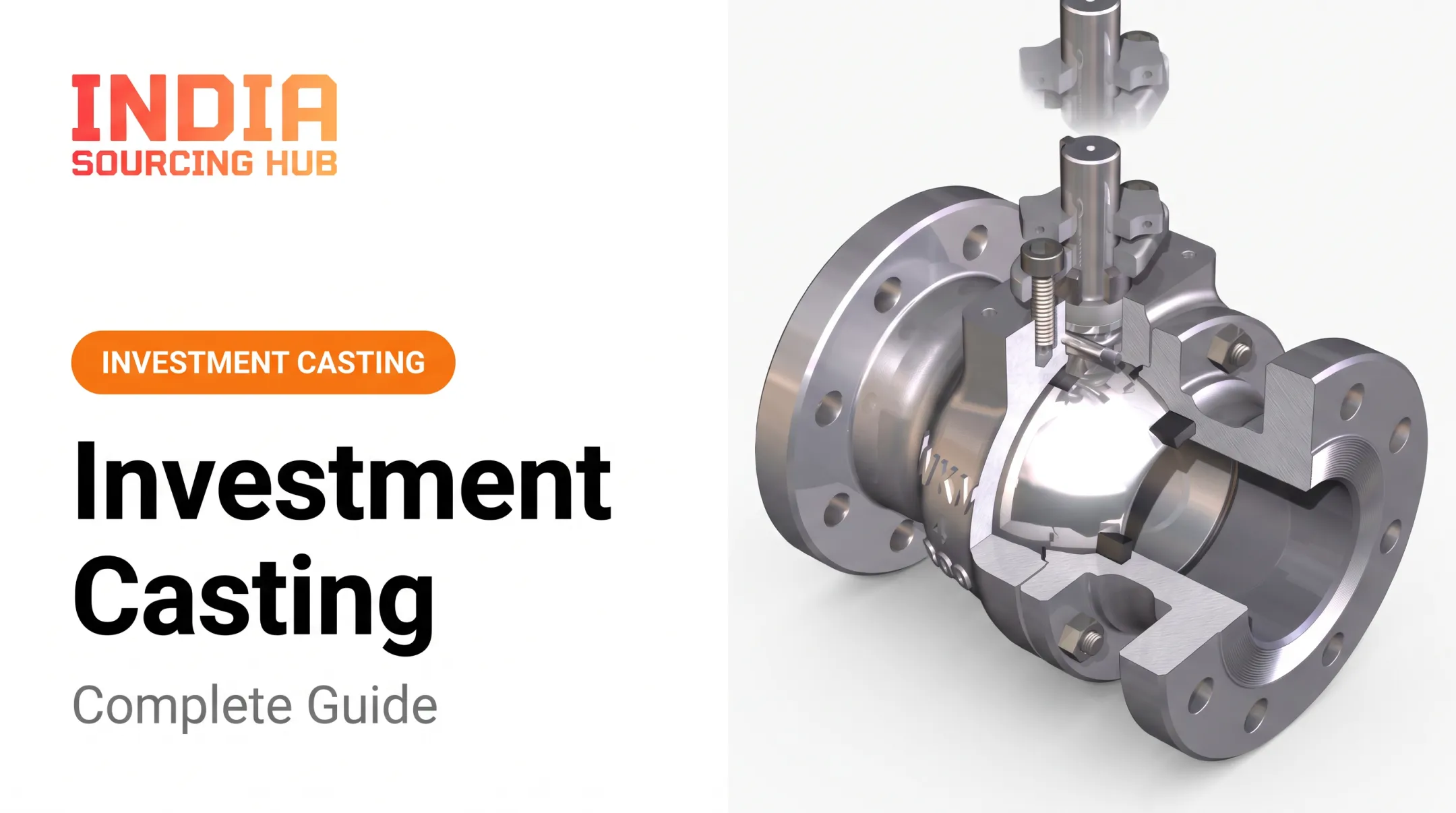
- Valve bodies and components
- Automotive and heavy-truck parts
- Industrial machinery and hydraulic components
- Electronics enclosures and heat-management parts
Qualifying a Supplier
Before tooling approval, confirm:
- Alloy capability matching your spec, not a substitute grade
- Tooling ownership terms: who keeps the pattern tool
- Process controls for shell building and pouring
- Dimensional inspection methods and reported tolerances
- Material certifications and heat-treatment records
- Corrective-action procedures for nonconformance
- First-article approval before full production release
Managing Overseas Sourcing
Sourcing from an overseas foundry adds layers most domestic buyers don't plan for:
- Drawing revision control
- Time-zone-sensitive communication
- Packaging and shipping terms
- Import responsibilities
- Buffer inventory for lead-time variability
This is where a sourcing partner earns its keep. India Sourcing Hub connects North American manufacturers with an Indian supplier network and manages technical requirements, quality expectations, and import logistics. Warehousing in Chicago and Toronto, with manufacturing support in Rajkot, keeps supply closer to your plant.
On-site inspection by India-based engineers happens before shipment. All-in pricing covers samples through production—useful when a buyer wants predictable costs without managing an overseas vendor relationship directly.

RFQ Checklist
Send suppliers these details for an accurate quote:
- 3D CAD and 2D drawings
- Alloy specification
- Annual and batch volume
- Prototype requirements
- Critical characteristics and tolerances
- Surface finish and heat-treatment needs
- Inspection standards
- Packaging and delivery location
- Required launch date
Conclusion: Making the Right Aluminum Investment Casting Decision
Aluminum investment casting earns its keep when complex geometry, lightweighting, and reduced machining justify the tooling and process investment. It is not automatically the cheapest route. It is the right choice when those conditions apply.
Compare qualified manufacturing routes using total landed cost and production risk, not tooling price or a quoted unit cost in isolation. A lower per-part number means little if machining, rework, or late delivery erase the savings.
Before approving tooling or selecting a supplier, get a feasibility review based on your actual drawing, alloy, volume, tolerance, and delivery requirements. That single step prevents most of the expensive surprises that show up later in a program.
Frequently Asked Questions
How much does it cost to cast an aluminum part?
Cost depends on geometry, alloy, weight, tooling, quantity, and any machining, finishing, or inspection. Request a quote from your drawing or CAD model rather than a generic estimate.
What is investment casting in aluminum?
It's the lost-wax process: a sacrificial pattern is coated in ceramic, removed, and replaced with molten aluminum to form a detailed, near-net-shape casting.
Can you investment cast aluminum?
Yes. Alloy selection, part geometry, wall sections, cores, and foundry capability determine feasibility for a specific design.
Is investment casting cheaper than die casting?
Neither is universally cheaper. Investment casting may reduce upfront tooling cost for some volumes and geometries, while die casting typically offers lower per-part costs at high volume.
What is investment casting good for?
It suits complex, detailed, lightweight, near-net-shape components that are difficult or costly to produce through machining, sand casting, or other methods.
What material is used for investment casting?
The process uses a sacrificial wax, resin, or printed pattern, a ceramic shell, and a selected casting alloy such as aluminum. The final alloy must match both the application and the supplier's demonstrated capability.