Introduction
Automotive die casting forces molten non-ferrous metal into a hardened, reusable die under high pressure. The result: a repeatable, near-net-shape part that often needs little additional machining.
Manufacturers rely on it because it solves a specific problem. Many engineering teams struggle to balance lightweighting, dimensional consistency, design complexity, and per-part cost across a production run that might stretch into the hundreds of thousands.
Die casting answers that tension directly. It delivers thin walls, integrated ribs, and smooth as-cast surfaces at production volumes that make tooling investment worthwhile.
This guide covers the materials, process types, common automotive applications, cost drivers, quality requirements, and the questions to ask before you select a supplier.
Key Takeaways
- Choose die casting for medium- to high-volume parts with repeatable geometry and tooling cost you can justify.
- Match aluminum, zinc, or magnesium to the part’s weight, strength, and detail needs—not a single default alloy.
- Treat process choice, die design, and porosity control as the gates that decide whether a casting meets the drawing.
- Plan for EV-driven demand in motor housings, battery enclosures, and thermal-management parts.
Automotive Die Casting: Definition, Benefits, and Limitations
Die casting works by injecting molten metal into a hardened steel die under significant pressure. The metal fills the cavity, cools rapidly, and gets ejected as a formed part. The die itself is reused thousands of times, which separates die casting from one-off molds.
Die casting differs from related processes:
- Sand casting and investment casting use disposable or semi-permanent molds, suited to lower volumes or more intricate shapes.
- Forging compresses solid metal into shape, producing different grain structure and strength characteristics.
- CNC machining removes material from a solid blank rather than forming it.
- Stamping works sheet metal, not molten metal.
Die casting typically forms most of a part's final geometry, with machining reserved for critical bores, sealing faces, or threaded features.
Why Automotive Buyers Choose Die Casting
Concrete advantages include:
- Repeatability across high-volume runs without shape drift
- Thin walls that reduce material use and part weight
- Integrated features like ribs and bosses that would otherwise require assembly
- Reduced machining on parts where the as-cast surface meets spec
That weight reduction is why lightweighting matters: vehicle weight affects fuel economy and, for EVs, driving range. The specific percentage gains vary widely by vehicle platform and application, so treat any fuel-economy claim with caution unless it's tied to a specific study or OEM test.
Where Die Casting Falls Short
Die casting isn't the default answer for every part. NADCA design guidance puts typical wall thickness in the 0.040–0.200 inch range (NADCA tolerance guidance). Thinner walls near 0.020 inch are possible on smaller parts only after consulting the caster directly. That window shapes what's realistic before you finalize a drawing.
Other limitations worth flagging early:
- Tooling investment only pays off at sufficient volume
- Alloys are limited to non-ferrous metals — no steel or iron
- Porosity is a known risk that needs agreed acceptance criteria
- Undercuts and massive sections complicate die design and slow cooling
If your part needs ferrous metal, runs in very low quantities, or carries heavy undercuts, a different process — forging, CNC machining, or investment casting — may fit better.

Common Materials Used in Automotive Die Casting
Three metals dominate automotive die casting, each solving a different design problem. None is universally "best." The right choice depends on the part's load, thermal exposure, and finish requirements.
Aluminum: The Workhorse Alloy
Aluminum alloys like A380 and A360 show up in transmission cases, motor housings, brackets, covers, and heat sinks. NADCA's alloy data lists engine brackets and transmission/gear cases among A380's documented automotive uses. A360 offers better corrosion resistance at the cost of slightly harder casting.
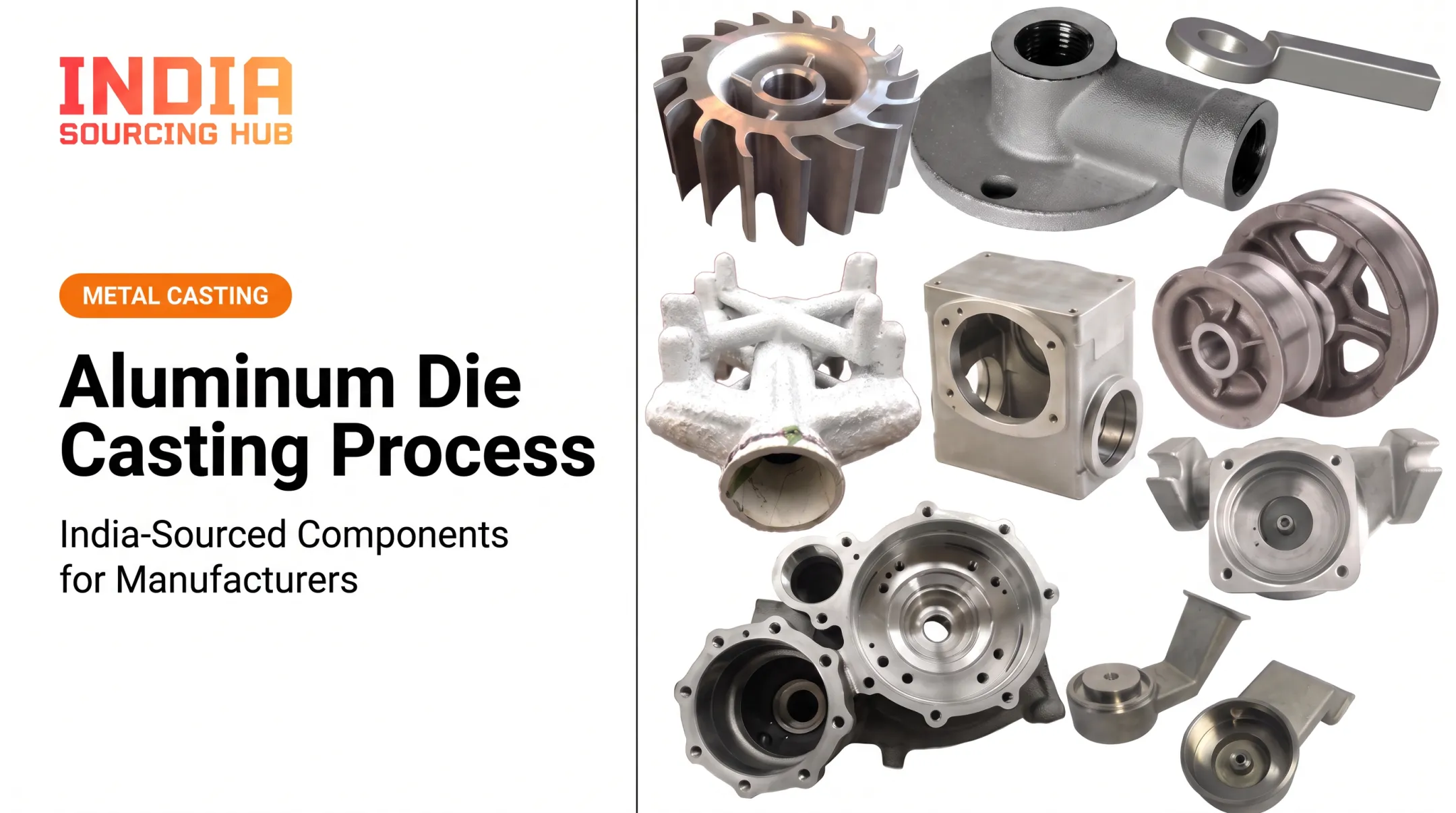
Battery-related enclosures and EV motor housings increasingly favor aluminum too, largely because it balances strength, machinability, and thermal conductivity. India Sourcing Hub's die-casting gallery includes an aluminum cylindrical housing with vertical cooling fins, a heat-dissipating enclosure typical of motor-related components in this category.
Zinc: Precision in Small Packages
Zinc alloys (Zamak 3, Zamak 5) excel at thin-wall detail and fine surface finish. Think lock housings, connectors, gears, and seatbelt-related hardware: parts where dimensional stability matters more than raw strength-to-weight ratio.
Zamak 5 specifically appears in documented steering-column housing applications, where its creep resistance outweighs the slightly lower ductility compared to Zamak 3.
Magnesium: Weight-Critical Applications
Magnesium alloys like AZ91D target weight-sensitive housings, brackets, and interior structures. Documented uses include transfer cases, cam covers, steering columns, and brake or clutch pedal brackets.
Corrosion protection requires more attention with magnesium than aluminum. Tight limits on iron, copper, and nickel impurities matter for long-term performance, so alloy certification should be part of your sourcing conversation.
| Material | Principal Advantage | Typical Applications | Compatible Process | Major Limitation |
|---|---|---|---|---|
| Aluminum | Strength-to-weight, thermal conductivity | Transmission cases, motor housings, heat sinks | Cold-chamber HPDC | Slower cycle than hot-chamber alloys |
| Zinc | Thin-wall detail, surface finish | Connectors, lock housings, gears | Hot-chamber HPDC | Higher density adds part weight |
| Magnesium | Lowest density | Steering columns, pedal brackets, housings | Hot-chamber HPDC (select alloys) | Corrosion sensitivity, handling precautions |
How the Automotive Die-Casting Process Works
A typical production run moves through a defined sequence:
- Design-for-manufacturing review and die design
- Alloy melting, injection, cooling, and ejection
- Trimming, machining, and inspection
Each stage carries its own failure points, which is why process selection matters as much as material choice.
Hot-Chamber vs. Cold-Chamber
Hot-chamber die casting keeps the injection mechanism submerged in molten metal, so cycles run faster without separate ladling for each shot. It suits zinc and select magnesium alloys, not standard aluminum, which would corrode the submerged components.
Cold-chamber die casting melts metal externally, then transfers it into the shot sleeve for plunger injection. This extra step makes it slower than hot-chamber casting, but it's the standard approach for aluminum and other higher-melting-point alloys.
Pressure Variants and Their Trade-offs
Beyond the hot/cold distinction, three pressure approaches matter for automotive parts:
- Conventional high-pressure die casting (HPDC): fast plunger fill, high output, standard for most complex automotive components
- Vacuum-assisted HPDC: evacuates air from the die cavity before filling to limit gas entrapment
- Low-pressure die casting (LPDC): furnace pressure pushes melt upward into the die from below; used mainly for aluminum wheels, where controlled filling supports structural integrity
One EU-funded study found no significant porosity difference between matched trials with and without vacuum assistance, so do not treat vacuum as an automatic porosity fix.

Defects and Prevention
Porosity remains the most commonly flagged concern. More than one in three die-casting purchasers and designers identified porosity as a common problem in a NADCA industry survey (NADCA porosity research). Define acceptance criteria for porosity before production starts rather than treating it as a reason to avoid die casting.
Common defect categories and their typical countermeasures:
- Gas porosity: improved venting, adjusted shot speed
- Shrinkage porosity: higher final compacting pressure, better feeding design
- Cold shuts and misruns: fill-pattern simulation, metal temperature control
- Soldering: die coatings, temperature management
- Flash: die maintenance, clamping force verification
Secondary operations finish what the die alone can't deliver:
- Gate removal
- CNC machining of bores and sealing faces
- Drilling and, where the alloy allows, heat treatment
- Leak testing and dimensional inspection
Automotive Die-Cast Parts and Emerging Applications
Die-cast components show up across nearly every vehicle system. Organizing by function helps clarify where the process adds the most value.
Powertrain and drivetrain:
- Transmission and gear case housings
- Engine brackets and covers
- Transfer cases
Chassis and controls:
- Steering column housings
- Brake and clutch pedal brackets
- Suspension brackets and covers
Electrical and sensing:
- Connectors
- Sensor and airbag housings
- Air-conditioning components
EV-Driven Demand
Electric vehicle production is expanding what gets die cast. Motor housings, inverter and heat-sink components, and battery tray structures increasingly rely on aluminum die casting for its thermal performance and weight savings. Each application still requires its own engineering validation: alloy, wall thickness, and sealing requirements vary by platform.
The Shift Toward Large Structural Castings
Manufacturers are consolidating multi-part welded assemblies into single-piece structural castings. Tesla's documented one-piece rear underbody casting, detailed in its own collision-repair manual, replaced dozens of separate components in a comparable assembly (Tesla rear underbody repair documentation).
Other manufacturers have announced similar directions. Toyota outlined plans for a BEV body built from three main cast components. That remains a stated strategy, not the same production reality as Tesla's shipped part. Keep proposed programs separate from documented production when evaluating the trend.
Large structural castings make process control even more critical. Robotics for part handling, in-line vision inspection, shot monitoring, and casting simulation improve repeatability and cut scrap in high-volume programs. Part selection still hinges on structural loading, thermal exposure, sealing needs, and downstream assembly.

Cost, Quality, and Automotive Die-Casting Supplier Selection
There's no universal price per pound for die casting. Cost depends on a combination of factors, and any supplier quoting a number without seeing your drawing is guessing.
What Actually Drives Cost
- Part size, weight, and geometry — more complex shapes mean more die work
- Alloy — aluminum, zinc, and magnesium carry different melt and tooling costs
- Die complexity and cavity count — single-cavity dies cost less upfront but produce at a slower rate
- Annual volume — higher volumes spread tooling cost across more parts
- Secondary operations — machining, finishing, and inspection add per-part cost
- Logistics — freight, duties, and inventory carrying costs
Tooling and engineering are one-time costs. Per-part production, machining, documentation, and shipping are recurring. Separating these two buckets early makes supplier quotes easier to compare apples to apples.
What to Include in Your Quote Request
A credible quote needs these details upfront:
- 3D CAD and 2D drawings with critical dimensions and GD&T called out
- Material and heat-treatment requirements
- Annual volume and typical order quantities
- Pressure or leak-test requirements, if applicable
- Surface finish and inspection standards
- Packaging, delivery terms, and target launch date
Quality Checks That Matter Before Production
Before committing to a production release, a supplier should provide:
- DFM feedback on the drawing before tooling starts
- Tooling approval sign-off at sampling stage
- Material certification tied to the specific alloy lot
- First-article inspection with a ballooned drawing and dimensional report
- X-ray or porosity testing where critical sections demand it
- Traceability and corrective-action procedures for ongoing production
Automotive buyers also typically need production parts to clear PPAP submission requirements and match the customer's quality system. Confirm which PPAP submission level applies before tooling begins.
Evaluating the Supplier, Not Just the Quote
Price and capability are only part of the picture. Ask about:
- Direct experience with your specific alloy and process (hot-chamber vs. cold-chamber)
- Who owns the tooling, and how maintenance and refurbishment are handled
- Machining integration — in-house or outsourced
- Communication practices and typical response times
- Capacity planning for volume ramps
- Export documentation and contingency planning for delays
This is where a managed sourcing relationship earns its keep. India Sourcing Hub connects US manufacturers with Indian metal-product suppliers for cast, machined, and forged automotive components. The team takes on coordination that typically eats engineering time:
- Technical requirement translation
- Supplier communication and quality expectations
- Import logistics and delivery planning
India-based engineers inspect production runs before shipment, and warehousing in Chicago and Toronto keeps inventory closer to North American plants. For manufacturers weighing tariff exposure on parts sourced from China, that India factory network offers a second-country supply option without the added duty burden.

If you're evaluating suppliers for an automotive casting or machined-component program, share your requirements with India Sourcing Hub for guidance tailored to your drawing and volume.
Frequently Asked Questions
How much does it cost to cast an aluminum part?
Cost depends on part weight, complexity, tooling requirements, annual volume, alloy, machining, inspection, and logistics. A credible quote requires a drawing and target quantity — there's no reliable flat-rate figure.
What is casting in the automobile industry?
Casting means forming molten metal into a component using a mold or die. Die casting specifically refers to the high-pressure variant, suited to repeatable non-ferrous automotive parts like aluminum housings and zinc connectors.
Is CNC better than casting?
CNC machining removes material from a solid blank, making it ideal for prototypes, low volumes, and tight-tolerance features. Casting is usually more economical for repeatable medium- or high-volume shapes. The right choice depends on geometry, volume, material, and tooling budget.
What are the four types of casting?
Common categories include sand casting, investment casting, die casting, and permanent-mold or gravity casting. Classifications vary by source, and high-pressure, low-pressure, and vacuum-assisted methods are all variants within die casting specifically.
Which metals are commonly used for automotive die casting?
Aluminum, zinc, and magnesium dominate automotive die casting. Aluminum balances strength and thermal performance, zinc delivers fine detail and dimensional stability, and magnesium offers the lowest weight for sensitive applications.
What should I ask an automotive die-casting supplier before placing an order?
Ask about their direct experience with your alloy and process, who owns and maintains the tooling, inspection and traceability practices, secondary machining capability, current capacity, and how sample approval works before production release.