Many engineers understand forged aluminum as "strong and light," but fewer understand what happens on the shop floor to get there. A part that looks identical on a drawing can perform very differently depending on alloy choice, die design, heat treatment, and inspection rigor.
This article walks through the process stages, the alloy and design factors that matter, the quality controls that separate a reliable supplier from a risky one, and the situations where forging isn't actually the right call. If you're specifying forged components for automotive, industrial, pump and valve, or transportation applications, this is the operational detail behind the marketing claims.
Key Takeaways
- Forging reshapes billets under compressive force; temperature, die design, and heat treatment set grain flow and final properties.
- Match open-die, closed-die, precision, or ring forging to part size, geometry, and production volume.
- Choose alloys by balancing forgeability, strength, corrosion resistance, and cost against real service conditions.
- Lock in quality with process control, documented heat treatment, dimensional inspection, and NDT when specified.
What Is the Aluminum Forging Process?
Aluminum forging permanently deforms a solid alloy billet under compressive loads. No material is melted or cut away. A press or hammer squeezes heated metal into a die cavity or between flat dies until it takes the planned shape.
The goal is a near-final component with:
- A controlled shape that requires minimal machining
- Grain structure that follows the part's contours rather than running randomly
- Lower risk of internal voids than a cast part of similar geometry
- Mechanical properties matched to the loading the part will see in service
Forging differs from three other common processes in how material gets shaped and what each one is good at:
- Casting pours molten metal into a mold and lets it solidify. It handles complex internal passages well but introduces porosity risk that forging generally avoids.
- Extrusion pushes heated aluminum through a steel die to create a continuous profile. It suits long, constant-cross-section shapes, not discrete, locally varying geometries.
- CNC machining removes material from solid stock. It's often the most economical choice at very low volumes since it skips dedicated tooling entirely.
Within forging itself, four process categories cover most production needs:
- Open-die forging — flat or simple-shaped dies, suited to large or simple parts and low volumes
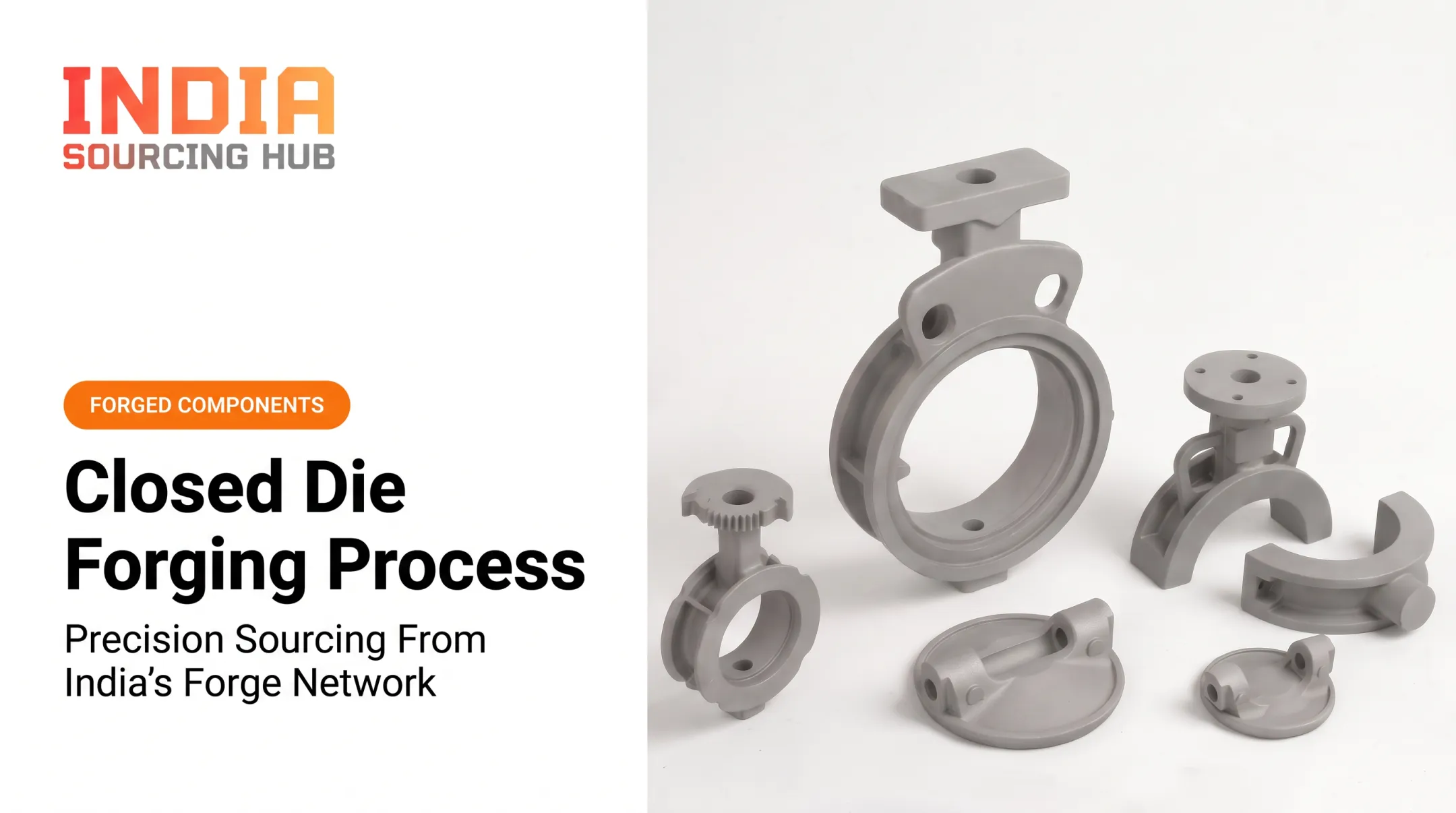
- Closed-die (impression-die) forging — matched die halves that fully enclose the workpiece, typical for production parts with defined geometry
- Precision (near-net-shape) forging — tighter-than-standard tolerances that cut downstream machining
- Ring rolling — produces seamless circular shapes like bearing races or flanges
Why Aluminum Forging Is Used
Manufacturers reach for forged aluminum when a part needs low density, strength-to-weight performance, fatigue resistance, and corrosion resistance in a geometry that suits a die.
Aluminum's density sits around 2.7 g/cm³, and high-strength 2xxx and 7xxx alloy families stay competitive on strength-to-weight for structural aerospace work, according to ASM International's materials reference.
That said, the evidence for a universal "forged beats cast" performance claim is thinner than marketing copy suggests. A frequently cited ASTM symposium study compared forged 6061-T6 against cast AC4CH-T6: the forged alloy showed higher plain-fatigue strength, but fretting-fatigue strengths for the two nearly coincided. These were different alloys being compared, not a controlled test of forging versus casting alone.

Where forging tends to earn its place:
- Suspension and structural automotive components
- Aerospace structural hardware and bulkheads
- Industrial machinery components under repeated or concentrated loads
- Pump and valve components exposed to pressure cycling
- Transportation and energy equipment parts
Forging can orient grain flow to follow a part's shape, which the Forging Industry Association links to potential benefits in impact and fatigue resistance. But final performance still depends on alloy, temper, geometry, process control, heat treatment, and inspection. The word "forged" on a spec sheet guarantees none of that on its own.
The trade-offs are real:
- Impression-die tooling costs money before the first part ships
- Secondary machining, heat treatment, and finishing add steps and cost
A 2021 Light Metal Age review of automotive suspension components found that for one comparison of forged-aluminum versus welded-steel control arms, the two designs ended up similar in size and weight, but the steel version cost substantially less. Test the whole component's economics, not just the material story.
How the Aluminum Forging Process Works
Getting from raw billet to finished part involves design review, alloy selection, heating, deformation, heat treatment, finishing, and inspection, in that order. Skipping any step raises quality risk.
Step 1: Design Review and Material Selection
Engineers review the drawing or 3D model against load cases, wall thickness, draft angles, radii, parting lines, and expected grain-flow direction before any tooling is designed. Production volume and alloy selection are locked in here, because both drive tooling cost and die layout.
Alloy families behave differently under the hammer:
- 6xxx (like 6061): ASM International describes 6061 as highly forgeable, with lower flow stress than harder-to-forge grades
- 2xxx (like 2014): higher strength, but ASM groups 2xxx among the more difficult-to-forge alloys
- 7xxx (like 7075): high strength and heat-treatable, but also harder to forge, with higher pressure requirements that can rule out certain rapid-strain-rate equipment
Step 2: Billet Preparation, Heating, and Preforming
Teams cut stock by sawing or shearing, inspect it, then heat it within a controlled window: hot enough to work, not so hot that it causes incipient melting or unwanted microstructural changes. There is no single forging temperature for all aluminum alloys. ASM's published ranges illustrate the spread:
| Alloy | Forging Range (°F) |
|---|---|
| 2014 | 785–860 |
| 6061 | 810–900 |
| 7075 | 720–820 |

Complex parts often go through a preform or blocker step first, distributing material roughly into position before the final die operation refines the shape.
Step 3: Die Forging and Material Flow
A press or hammer drives the heated billet into an open or closed die. In closed-die forging, excess material squeezes out as flash, which is trimmed later. Die temperature, lubrication, stroke speed, applied force, and fill sequence all affect whether the metal completely fills the cavity.
Thin walls, deep cavities, or tight tolerances often call for:
- Multi-stage forging across several die operations
- Hot-die or isothermal forging to maintain flow temperature longer
- Precision forging to approach net shape and reduce machining
Step 4: Trimming, Heat Treatment, and Finishing
Flash is removed, parts are straightened if needed, and heat-treatable alloys go through solution treatment, quenching, and artificial aging to reach their specified temper. ASM notes that 1xxx, 3xxx, and 5xxx alloys are exceptions to this sequence: not every aluminum forging is quenched and aged.
Quench distortion is a real risk. Complex shapes and uneven racking during immersion can introduce residual stress that needs straightening afterward.
Machining, deburring, and surface treatment usually follow to hit final dimensions and corrosion-protection requirements.
Step 5: Inspection and Release
Before release, parts typically go through material certification, chemical analysis, hardness and mechanical testing, dimensional inspection, and non-destructive testing where the specification calls for it. ASTM B247 covers aluminum die forgings, hand forgings, and rolled ring forgings, including composition and mechanical-property requirements, and is a common reference point on purchase drawings.
Lot traceability and process documentation confirm that today's production run matches the approved sample that qualified the part.
Where Aluminum Forging Is Applied and How to Choose It
Forged aluminum is used in automotive and truck components, aerospace structures, pump and valve parts, industrial machinery, and energy equipment.
Decision points typically arise during initial design, a redesign for weight reduction, replacement of a cast or machined part, or a supplier diversification push.
Before requesting quotes, work through this checklist:
- Service loads, fatigue requirements, and operating temperature range
- Corrosion exposure and weight targets
- Dimensional tolerances and annual volume
- Tooling budget and machining allowance
- Required documentation and applicable standards (ASTM, SAE, AMS)
Choosing between methods comes down to geometry, size, volume, and tolerance:
- Open-die forging — large, simpler shapes, low volumes
- Closed-die forging — defined geometry, moderate-to-high volume
- Precision forging — tight tolerances, less machining
- Ring rolling — seamless circular parts
- Casting — complex internal passages forging can't reach
- Extrusion — long, constant-profile sections
- Machining — very low volumes or features a die simply can't produce
For procurement teams, a complete RFQ package should include:
- Drawing or CAD file
- Alloy and temper requirements
- Quantity forecast
- Inspection expectations
- Packaging requirements
- Delivery location
Supply-chain structure matters as much as the forging itself. India Sourcing Hub works with North American manufacturers evaluating qualified Indian suppliers for forged aluminum and related metal components.
The team coordinates quality requirements, import logistics, inventory, and warehousing so companies aren't managing overseas vendor relationships alone. Forged components move through the company's network to warehouses serving Chicago and other North American locations, with engineers in India inspecting production runs before parts ship.
Key Factors That Affect Aluminum Forging Quality and Cost
Quality and cost trace back to the same handful of variables, whether you're buying one prototype or a running production order. Get these wrong and you pay in scrap, rework, and schedule slips; get them right and both quality and unit cost stay predictable.

Inputs and materials:
- Alloy series and billet chemistry
- Starting stock dimensions and cleanliness
- Temper and heating uniformity
- Material certification
Operating conditions:
- Forging and die temperature matched to the alloy's process window
- Deformation rate and press or hammer capacity
- Lubrication, reduction ratio, and cooling rate
Tooling and equipment:
- Die design, draft angles, fillets, and parting line placement
- Die wear and press alignment
- Furnace control accuracy
Scale and throughput:
- Prototype versus production quantity
- Tooling amortization and billet utilization
- Flash, scrap rate, and cycle time
Secondary operations:
- Heat treatment and straightening
- CNC machining, drilling, and surface finishing
- Cleaning, packaging, and inspection
Safety and compliance:
- Worker protection around heated metal and high-force equipment
- Lot traceability and documented process control
- Customer-specified standards and non-conformance procedures
Total landed cost is broader than the per-piece forging line on a quote. Budget for the full stack:
- Raw material, tooling, and forging operations
- Energy, labor, heat treatment, and machining
- Inspection, packaging, freight, and duties
- Inventory carrying cost
Buyers who score suppliers only on piece price often miss the largest swings, which usually sit in tooling amortization, scrap, secondary machining, and freight.
Common Issues, Misconceptions, and Limitations
Not every aluminum alloy or geometry is a good forging candidate. Alloy response, equipment capacity, production volume, and required properties all determine feasibility — and forging doesn't automatically eliminate every defect or guarantee a specific strength level.
Risks that still require process control:
- Incomplete die fill or laps
- Cracks, especially surface-connected ones detectable by penetrant testing
- Distortion from uneven quenching
- Dimensional variation from die wear or misalignment
A common point of confusion: a part's process (forged) and its properties (strength, fatigue life) aren't the same thing. Alloy, temper, grain flow, heat treatment, geometry, and inspection all contribute to how the part actually performs.
Signals that forging may not be the right fit:
- Low quantities that can't justify tooling cost
- Highly intricate internal passages
- Extremely thin or undercut features requiring machining anyway
- Shapes beyond available press capacity
Those same limits show up when you choose a supplier. Overseas forging capability varies widely on process control, so documented quality systems and third-party factory inspection matter as much as press capacity for U.S. buyers who need consistent drawing compliance and performance.
Conclusion
Aluminum forging combines material selection, heating, deformation, die design, heat treatment, finishing, and inspection into a sequence engineered for each application.
Choose the right process by weighing performance needs, geometry, production volume, tooling cost, and total landed cost against casting and machining alternatives.
Before committing to forged aluminum, validate the alloy and temper against your actual service conditions. Request documented process and inspection information rather than taking "forged" as a quality guarantee on its own.
India Sourcing Hub has sourced metal products for North American manufacturers since 1995, building an Indian factory network that has met its quality requirements since 2013. Third-party factory inspection is built into that process, with on-staff engineers reviewing production runs before shipment.
Frequently Asked Questions
Can aluminum alloy be forged?
Yes. Many aluminum alloys can be forged, though forgeability, temperature range, and final properties vary by alloy, temper, and geometry. Equipment capacity also matters for harder-to-forge grades.
Can 6061 aluminum be forged?
Yes. ASM describes 6061 as highly forgeable with lower flow stress than harder grades. Geometry and production volume still decide whether forging is the right route for a given 6061 part.
What is the process of aluminum alloy forging?
It involves billet preparation, controlled heating, preforming, die forging, trimming, heat treatment, machining or finishing, and inspection. Each step affects the final part's dimensional accuracy and mechanical properties.
What is the ideal forging temperature for aluminum?
There is no single temperature for all alloys. 2014, 6061, and 7075 each have different ASM-recommended ranges. Overheating risks incipient melting; too little heat risks incomplete die fill and cracking.
How strong is forged aluminum alloy?
Strength depends on alloy, temper, grain flow, heat treatment, geometry, and test direction. Always check verified mechanical-property data for the specific alloy and condition you're specifying, not a generic "forged" claim.
How do you tell if aluminum is cast or forged?
Visual inspection alone is unreliable. You typically need production records, material certifications, grain-flow evidence, and microstructural examination to confirm the manufacturing route.