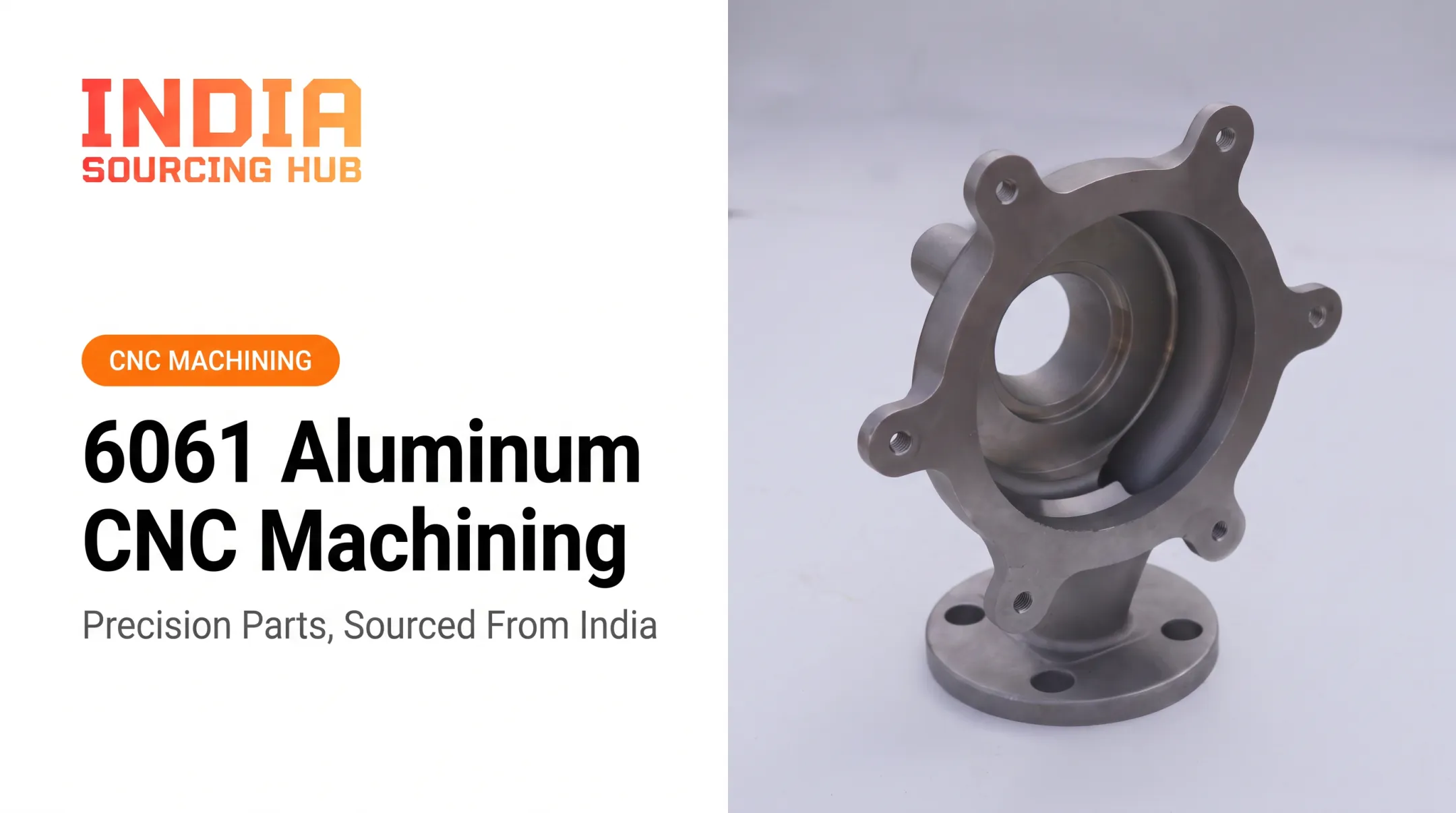
A pump housing might be cast to get its internal passages and mounting bosses close to final form, then machined to create a sealing face that actually seals. Engineers and buyers sourcing these parts juggle several variables at once:
- Part geometry and wall thickness
- Annual production volume
- Tolerance and surface-finish requirements
- Alloy selection
- Tooling budget and lead time
- Minimum order quantity
- Total landed cost, not just unit price
This article walks through casting methods, machining operations that follow casting, how to pick between casting, machining, or a hybrid approach, and what to check before committing to a supplier.
Key Takeaways
- Casting builds complex, near-net-shape aluminum parts efficiently; CNC machining adds the precision casting alone can't deliver
- Method selection depends on volume, geometry, surface finish, porosity control, and tooling budget
- Post-cast machining typically targets bores, threads, sealing faces, and mating surfaces
- A hybrid approach (cast the body, machine the critical features) is often the most practical, cost-effective route
Aluminum Casting Methods
Aluminum casting means pouring or injecting molten aluminum alloy into a mold cavity shaped like the finished part. Different mold types trade off cost, repeatability, and geometric freedom in different ways.
The general sequence includes:
- Alloy selection and mold or die preparation
- Melting, then pouring or injection
- Solidification, shakeout or mold removal
- Finishing, inspection, and sometimes heat treatment
Sand Casting
Sand casting forms a cavity by packing sand around a pattern, then breaking the mold apart after the metal solidifies. Stanford's product realization program describes pouring aluminum into a prepared sand mold and machining the resulting casting afterward to produce a finished, usable part.
This method suits:
- Prototypes and low-to-mid production volumes
- Large components that would be expensive to tool for die casting
- Complex shapes requiring sand cores for internal passages
The trade-off is rougher surface finish, wider dimensional tolerances, and more machining allowance than permanent mold or die casting.
Design guidance for sand-cast aluminum generally calls for:
- Uniform wall sections
- Draft angles on vertical faces to allow pattern removal
- Generous fillets at corners to reduce stress concentration and improve fill
- Extra stock on surfaces that will be machined to final size
Permanent Mold and Gravity Casting
Permanent mold casting uses a reusable metal mold instead of sand, which is broken apart every cycle. That reusability improves repeatability, surface finish, and cycle time compared to sand casting, making it attractive once production volume justifies the tooling.
Gravity-fed permanent mold casting relies on the pull of gravity to fill the mold, as opposed to pressure-assisted processes. This difference matters:
- Gravity filling tends to produce lower turbulence and lower entrapped gas porosity
- Pressure-assisted filling fills faster and supports thinner walls, but can trap more gas
- Permanent mold tooling costs more upfront than sand tooling but less than die-casting dies
Permanent mold isn't always the right fit for parts with intricate internal geometry, since complex cores are harder to incorporate into a reusable metal mold than a sand one.
Die Casting
High-pressure die casting injects molten aluminum into a reusable steel die under significant pressure. It's built for repeatability at volume, with faster cycle times, better surface finish, and often less secondary machining than sand or permanent mold castings.
The limitations are real:
- Die tooling investment is substantial, and NADCA identifies die manufacture, replacement, and secondary operations as ongoing cost factors, not one-time expenses
- Not every alloy is suited to high-pressure filling
- Part size is constrained by available press tonnage
- Thin-wall capability comes with trapped-gas risk, which can limit heat treatment options
- Structural requirements need validation since die castings can carry porosity that affects fatigue life
Investment, Lost Foam, and Other Specialized Methods
Investment casting (lost wax) and lost foam casting both use expendable patterns, wax or foam, that are removed or displaced as the mold fills. These methods shine when a part has intricate geometry, internal features that would be impossible to core out of sand or metal, or a shape that's simply hard to tool conventionally.
They aren't automatically the right call for every project. Compare them against the other methods using:
| Criteria | Sand | Permanent Mold | Die Casting | Investment/Lost Foam |
|---|---|---|---|---|
| Complexity handling | High | Moderate | Moderate-High | Very High |
| Typical volume | Low-Mid | Mid | High | Low-Mid |
| Tooling cost | Low | Moderate | High | Moderate-High |
| Surface finish | Fair | Good | Very Good | Excellent |
| Machining needed after | More | Moderate | Less | Least |
Alloy Selection and Cast-Part Performance
"Cast aluminum" almost always refers to an aluminum alloy, not pure aluminum. The alloy you choose affects castability, strength, corrosion resistance, response to heat treatment, machinability, weldability, and service temperature limits.
Commonly specified casting grades include:
- 319 and 356/A356: sand and permanent mold alloys. The Aluminum Association's published chemistry lists 356.0 at roughly 6.5-7.5% silicon and 0.20-0.45% magnesium, with A356 carrying a tighter copper limit for better ductility
- 380 and 413: die-casting alloys, with 380 offering a practical balance of strength and castability, and 413 offering higher silicon content for improved fluidity in thin sections
The right grade depends on the application, not a generic preference. A356-T6, for example, shows up in both permanent mold and V-process castings in published industry case studies, but that doesn't make it the default for die casting.
CNC Machining of Aluminum Castings
CNC machining is a subtractive process: a cutting tool removes material from a workpiece to create precise features. Machining a cast blank differs from machining billet, plate, or bar stock.
A casting starts closer to final shape, so machining time and scrap are typically lower. Parting lines, minor porosity, and as-cast skin still need their own process planning.
Why Cast Parts Are Machined After Casting
Casting is good at producing overall geometry efficiently. It is not always good at producing:
- Precision bores and bearing seats
- Threaded holes
- Sealing faces and gasket surfaces
- Mounting surfaces and datums
- Mating features that need to line up with another component
Machining also removes gates, flash, and parting-line material left over from the casting process, cleaning up the part while preserving the geometric and cost advantages of starting from a near-net shape.
Common CNC Operations
Several operations typically follow casting:
- Milling for flat surfaces, pockets, slots, contours, and complex profiles
- Turning for cylindrical features on rotationally symmetric parts
- Drilling and tapping for holes and threaded connections
- Boring for accurate internal diameters, such as bearing or seal bores
- Facing for controlled, flat reference surfaces
Those cuts only hold if the casting is held correctly. Fixture design and workholding matter as much as the toolpath, because castings aren't perfectly uniform—datum selection, tool access, and multi-axis capability drive how accurately finished features repeat.
Alloy Machinability and Cutting Considerations
Aluminum in general machines well, but not every aluminum alloy behaves the same way under a cutting tool. Silicon content, temper, hardness, porosity, inclusions, and heat-treatment condition all affect tool wear, chip control, burr formation, and surface finish.
A common question: is 6061 aluminum machinable? Yes—wrought 6061 is one of the easiest aluminum alloys to machine, which is why many CNC suppliers list it as a go-to billet choice. But 6061 is a wrought alloy, not a casting alloy.
Cast components are typically specified in grades like A356, 319, 380, or 413, with different silicon levels and machining behavior than 6061. Higher-silicon casting alloys are more abrasive on cutting tools, so tooling suppliers group cast aluminum separately from wrought grades.

Tolerances, Surface Finish, and Machining Allowance
Casting tolerances and CNC machining tolerances are not the same specification, and treating them as interchangeable causes problems on drawings. The practical approach:
- Cast features near-net where tight tolerance isn't functionally required
- Call out machining only on features that actually need it: bores, threads, sealing faces, datums
- Leave adequate machining stock on surfaces that will be cut to final size, confirmed with your casting and machining supplier rather than assumed
ISO and ASTM standards address casting tolerances, machining allowances, and general dimensional tolerances separately. Which standard applies depends on alloy, process, and what the drawing actually calls out—confirm that with your supplier.
Benefits and Limitations of CNC Machining Aluminum Castings
Benefits:
- Design flexibility for features that casting can't economically produce
- Precise, repeatable functional features
- Quick setup changes, useful for prototypes and design iterations
- Works well alongside low-volume or evolving designs
Limitations:
- Removes material and generates scrap
- Workholding gets complicated on irregular cast shapes
- Tool access can be limited on deep or internal features
- Machining too deep can expose subsurface porosity
- Per-part cost climbs at high volumes compared to near-net-shape casting alone
How to Choose Between Casting, Machining, and a Hybrid Process
Casting, machining from solid, and hybrid processes compare across production volume, part complexity, tolerance needs, tooling investment, lead time, material utilization, and total landed cost. None of them wins on every criterion.
When Casting Is Usually Appropriate
Casting tends to make sense when:
- Geometry is complex or includes hollow internal passages
- Material savings matter at volume (less wasted metal than cutting from solid)
- Production volume justifies the tooling investment
- Multiple features can form close to final shape in one operation A pump impeller is a good example. Its curved vanes and internal passages are difficult and wasteful to machine from billet, but they're a natural fit for casting, with the mounting bore and shaft seat machined afterward for precision.
When Machining From Solid Stock Is Usually Appropriate
Machining from billet often wins when:
- Volumes are low and tooling for a casting pattern or die can't be justified
- The design is still changing frequently during development
- Geometry is simple enough that material waste isn't a major cost driver
- Tolerances are tight across most of the part, not just a few features The real comparison isn't raw material price. It includes programming time, setup, scrap, inspection, and lead time, all of which can make machining from solid more expensive per part than it first appears, even when tooling cost is zero.
When a Hybrid Process Is the Strongest Choice
For many industrial components, casting the main body and machining only the critical features is the most practical balance. The cast blank handles geometric complexity and material efficiency. Machining handles the handful of features (bores, threads, sealing surfaces) that actually need tight control. This approach also supports product development. A part can start as a machined prototype from billet, then transition into a cast-and-machined design once volume and design requirements are validated, without redesigning the part from scratch.

Cost and Break-Even Analysis
Tooling is an upfront, fixed cost. Per-part cost is recurring. The break-even point between them depends on:
- Production quantity
- Part weight and alloy
- Geometric complexity
- Tooling life and expected die wear
- Machining time per part
- Inspection and packaging requirements
- Freight, duties, and inventory carrying cost
- Risk and cost of rejected parts NADCA groups die-casting economics into material, processing, tooling, and post-processing cost categories. Tooling is only one piece of the total picture. Published industry case studies have shown cost reductions of 80% or more when converting a billet-machined part to a cast design at sufficient volume, but results like that are specific to the part and process, not a guarantee. Treat any benchmark as directional and get a project-specific quote before committing.
Design, Quality, and Sourcing Considerations
Design for Manufacturability
Good cast-and-machined part design starts on the drawing, not in the shop. Key practices:
- Uniform wall sections to reduce shrinkage and warping
- Appropriate draft angles for mold or die release
- Generous fillets at transitions to reduce stress concentration
- Clear core access for internal features
- Defined machining datums so inspection and tooling agree on reference points
- Realistic tolerance callouts, tight only where function demands it
Specifying tight tolerances across an entire part when only two or three features actually need them adds machining time, scrap, and cost without adding value.
Quality Assurance From Casting Through Machining
A complete quality plan typically covers:
- Alloy certificates and melt chemistry verification
- Process records for temperature and cycle parameters
- Visual and dimensional inspection
- Porosity or internal-defect testing where the application calls for it
- Heat-treatment verification
- CMM inspection for critical dimensions
- Surface-finish checks
- First-article approval before full production
Confirm which ASTM, SAE, ISO, or customer-specific standards actually apply to your alloy and process before assuming a certification covers your part. A general-purpose casting specification, for instance, may explicitly exclude safety-critical or highly loaded applications.
Selecting and Managing an Overseas Supplier
Sourcing cast and machined aluminum parts overseas adds a logistics layer on top of the technical decisions. A practical qualification checklist:
- Review drawings and CAD files with the supplier before quoting
- Confirm factory capability against your alloy, process, and volume
- Approve samples or prototypes before production release
- Request process-control documentation and inspection plans
- Establish clear communication channels and response expectations
- Clarify order quantities, packaging, and import logistics upfront
- Define corrective-action procedures before problems happen, not after

When you need that overseas layer managed rather than built in-house, India Sourcing Hub connects US manufacturers with a vetted Indian factory network for aluminum cast-and-machined parts, plus related cast and CNC work in other metals.
What that network typically covers:
- Investment, sand, and die-cast components with CNC machining
- Engineer inspection of production runs before shipment
- Warehousing in Chicago and Toronto so MOQs block fewer smaller runs
- An alternative to China-made parts that avoids the current 25% tariffs
None of this replaces your own supplier qualification. Verify factory capability, certifications, and tolerance capability against documentation for your specific part before committing to production.
Conclusion
Aluminum casting and CNC machining work best as complementary processes. Casting establishes efficient, near-net geometry. Machining delivers precision exactly where the design requires it.
Before choosing a process or a supplier, evaluate these factors together:
- Drawing requirements and alloy selection
- Production volume and tolerances
- Tooling investment and quality plan
- Total landed cost
If you're sourcing cast-and-machined aluminum components and need a qualified manufacturing partner, talk to India Sourcing Hub about your production and sourcing requirements.
Frequently Asked Questions
How much does it cost to cast aluminum?
Cost depends on alloy, part weight, geometry, casting method, tooling, order quantity, machining, inspection, finishing, and freight. Request a project-specific quote rather than relying on general estimates.
What are three methods of casting aluminum?
Sand casting, permanent mold casting, and die casting are the three most common methods. The best choice depends on your volume, geometry, tolerance requirements, and tooling budget.
Is CNC aluminum stronger than cast?
CNC machining is a process, not a material condition, so this comparison depends on whether the stock is wrought or cast. Strength depends on alloy, temper, heat treatment, porosity, and grain structure.
Is 6061 aluminum machinable?
Yes, 6061 is widely regarded as one of the most machinable aluminum alloys. It's primarily a wrought alloy, though, and isn't automatically the right choice for a cast component.
Is aluminum hard to cast?
Aluminum is widely cast across industries, but reliable parts require controlling mold design, melt quality, filling, solidification, shrinkage, gas porosity, and alloy selection.
How thin can aluminum be machined?
Minimum practical thickness depends on alloy, part size, unsupported span, tool diameter, workholding, and tolerance requirements. Confirm minimum feature thickness with your machining supplier during design review.